Grid-Forming Inverters and Their Influence on Power System Stability
Learn how grid-forming inverters improve frequency support, voltage regulation, fault behavior, and small-signal stability in modern low-inertia power systems.
Power systems are changing faster than many planning rules were written for. As synchronous machines retire and inverter-based resources such as solar PV, battery energy storage systems, and some wind plants take a larger share of generation, the grid loses part of the electromechanical behavior that historically made frequency and voltage response easier to predict. That shift is one reason grid-forming inverters have become one of the most discussed technologies in modern power engineering.
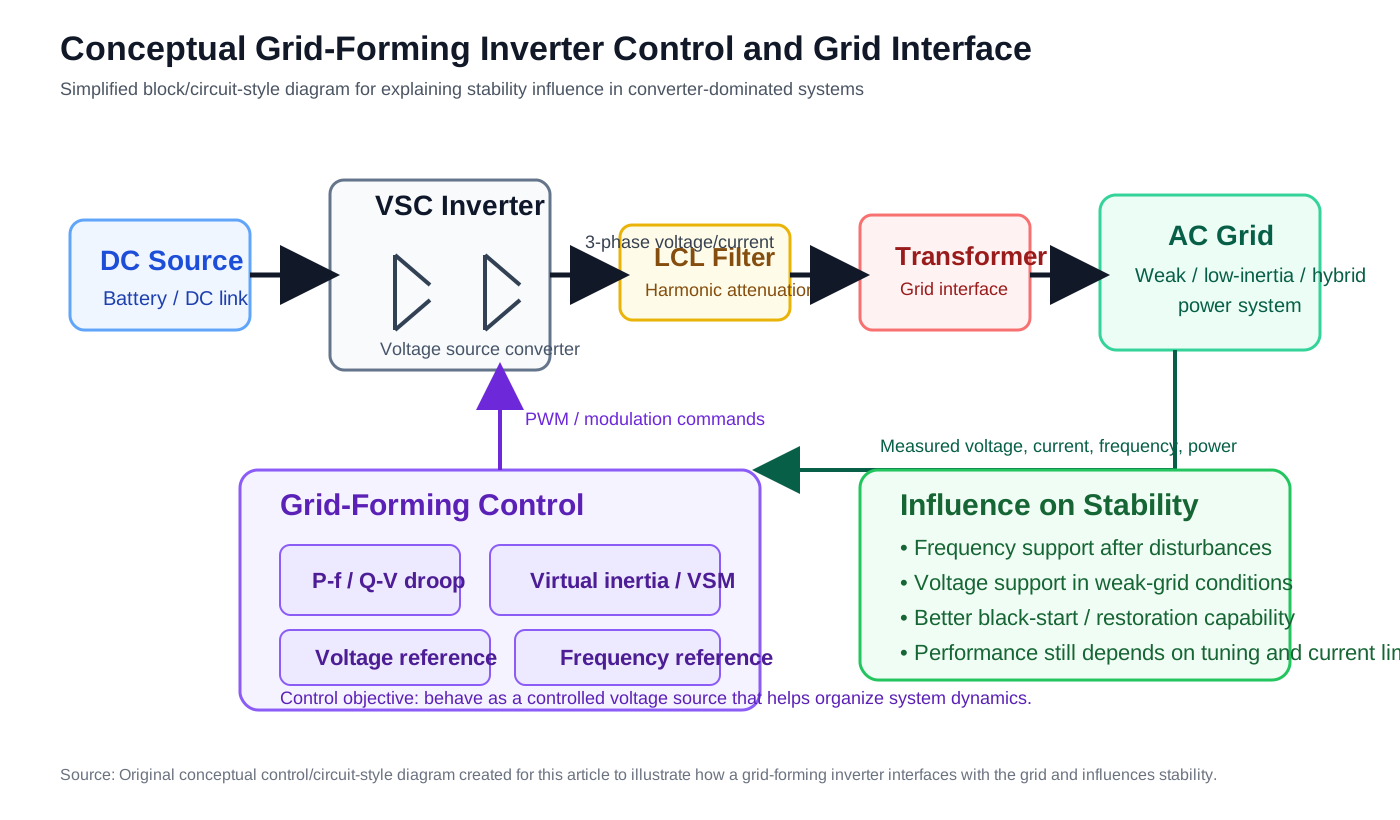
Unlike conventional grid-following inverters, which synchronize to an existing grid voltage using a phase-locked loop, a grid-forming inverter can establish its own voltage waveform and frequency reference. In practical terms, that means it can behave more like an active source that helps organize the grid rather than a device that simply injects current into it. The result is a major influence on power system stability, especially in low-inertia or weak-grid conditions.
What is a grid-forming inverter?
A grid-forming inverter is a power electronic converter controlled to regulate voltage magnitude and frequency directly, rather than only tracking an externally imposed grid signal. Different implementations exist, including droop-based control, virtual synchronous machine or synchronverter concepts, dispatchable virtual oscillator control, and related hybrid schemes. The exact algorithm differs, but the shared idea is simple: the inverter contributes to grid-forming behavior rather than depending on a stiff voltage source already being present.
That distinction matters because traditional inverter controls were designed for grids dominated by synchronous machines. In those systems, the “grid” was already well defined. In a converter-dominated system, that assumption breaks down.
Why is stability harder in low-inertia systems
Classical power systems benefited from the physical inertia of large rotating machines. When a disturbance occurred, that stored kinetic energy slowed the rate of frequency change and helped keep the system coherent long enough for governors, exciters, and protection systems to act.
As converter-based generation grows, several challenges become more visible:
1. Faster frequency dynamics
Lower inertia usually means a faster rate of change of frequency after disturbances. That gives operators and controls less time to respond.
2. Weaker voltage reference
Grid-following inverters require a reliable external waveform for synchronization. In weak systems, phase-locked loops can interact poorly with network impedance, causing oscillations or instability.
3. Different fault behavior
Synchronous generators can supply a large fault current for a short duration. Inverters are current-limited by design, so protection and transient behavior look very different.
4. More control-to-control interaction
When many converters interact through fast control loops, system stability is no longer dominated only by machine electromechanics. Inner loops, current limits, digital delays, and network impedance all matter more.
How grid-forming inverters influence power system stability
Grid-forming inverters can improve stability, but they do not do it automatically. Their influence depends on the control design, plant tuning, current-limited strategy, and system context.
Frequency stability and inertial response
One of the best-known benefits of grid-forming controls is improved frequency support. A well-designed grid-forming inverter can emulate inertial and primary-frequency-like behavior through droop or virtual-synchronous dynamics. This helps arrest frequency excursions after generation-load imbalance and can reduce dependence on synchronous machines for immediate frequency response.
However, engineers should be careful with the phrase “virtual inertia.” It is useful, but it is not identical to physical rotating inertia. The response comes from control action and energy storage limits, not from electromechanical momentum. That means the quality and duration of the response depend on energy availability, converter limits, and supervisory logic.
Voltage stability and weak-grid operation
Grid-forming inverters are especially valuable in weak systems because they can regulate voltage directly and establish a local voltage source. This reduces the dependence on PLL-based synchronization and can make systems more robust when short-circuit strength is low.
This does not mean every grid-forming plant is automatically stable in weak grids. Research shows that impedance interactions, control bandwidth choices, and network strength still matter. But compared with grid-following controls, grid-forming operation generally gives planners a stronger toolset for maintaining voltage and synchronizing converter-rich networks.
Small-signal stability
Small-signal stability concerns how the system responds to small disturbances around an operating point. In inverter-dominated systems, oscillatory modes can emerge from controller interactions, especially between converter controls and the surrounding network.
Recent journal work shows that grid-forming converters can improve small-signal stability margins, especially when they reduce PLL-driven interactions or provide better damping. At the same time, some papers also show that poor tuning, weak-grid conditions, or inappropriate current-limiting behavior can introduce new unstable modes. In other words, grid-forming control is not a magic switch; it is a new design space that can be better than grid-following control when engineered properly.
Transient stability
Transient stability refers to the system's ability to remain synchronized after large disturbances, such as faults, line trips, or sudden generation loss. Grid-forming inverters can enhance transient stability by actively maintaining voltage-angle and magnitude references. That can improve post-disturbance recovery, black-start capability, and operation in systems with scarce synchronous generation.
But transient performance depends heavily on current limitations. When a severe disturbance occurs, the inverter cannot simply push unlimited current like a large synchronous machine. Many recent studies emphasize that the converter current limiter design is central to whether a grid-forming resource helps or harms transient behavior during major faults.
Fault ride-through and protection implications
A power system with more grid-forming inverters does not just behave differently in steady state. It also behaves differently during faults. Fault currents are typically lower and more tightly controlled, which has direct consequences for relay coordination, protection sensitivity, and restoration logic.
This means the stability conversation cannot be separated from protection engineering. A converter may be dynamically stable from a control standpoint while still requiring significant protection redesign at the system level.
Grid-forming vs grid-following: stability perspective
The cleanest way to frame the comparison is this:
- Grid-following inverters are efficient at injecting power into a healthy grid but become more difficult to manage as system strength declines.
- about grid-forming technology, but the literature also suggests that inverters are better suited to establishing voltage and frequency behavior in low-inertia or converter-dominated systems, but they demand more careful system-level tuning and protection coordination.
In practice, future power systems are likely to contain both. Many researchers now focus on hybrid grids, where a smaller number of grid-forming resources stabilize a larger fleet of grid-following resources.
Where grid-forming inverters help the most
Based on current literature, grid-forming inverters appear particularly valuable in these situations:
Black start and system restoration
Because they can establish voltage and frequency, grid-forming inverters are promising for black-start support and staged system restoration.
Islanded microgrids
They are naturally suited to isolated or islanded operation where no strong external grid reference exists.
Weak-grid renewable integration
They help improve voltage and synchronization behavior in regions with low short-circuit strength.
Stability support in high-IBR systems
They can provide stabilizing services that become more important as synchronous generation retires.
Key limitations engineers should not ignore
There is a lot of justified excitement about grid-forming technology, but the literature also makes clear the caveats.
Energy limits are real
An inverter cannot sustain frequency support without an energy source behind it, usually a battery, curtailed renewable headroom, or another controlled source.
Current limits are decisive
Large-disturbance performance often depends less on the idealized control law and more on what happens when the current saturates.
Plant-level tuning is not enough
A grid-forming unit may appear stable in isolation, but it interacts poorly with neighboring converters, lines, transformers, or plant controllers.
Protection practices may need redesign
Legacy protection assumptions built around synchronous fault current do not always transfer cleanly.
What the journal literature is converging on
The strongest technical trend across recent literature is not that grid-forming inverters solve every problem, but that they are becoming a foundational tool for maintaining stability in converter-rich systems. The main points of agreement are:
- They improve the feasibility of operating low-inertia systems.
- They can enhance frequency and voltage stability relative to purely grid-following portfolios.
- Their benefits depend strongly on controller tuning, network strength, and current-limit behavior.
- Hybrid architectures with both grid-forming and grid-following resources are likely to dominate in the near to medium term.
That is probably the most balanced engineering takeaway: grid-forming inverters are not a silver bullet, but they are becoming one of the most important stability enablers in the energy transition.
FAQ
Are grid-forming inverters the same as virtual synchronous machines?
Not exactly. Virtual synchronous machine control is one type of grid-forming strategy. Other methods include droop-based control and virtual oscillator control.
Do grid-forming inverters replace synchronous generators completely?
Not necessarily. In many systems, they will complement, rather than immediately replace, synchronous machines. The transition is likely to be hybrid for quite a while.
Why are grid-forming inverters better in weak grids?
Because they can regulate voltage and frequency directly instead of relying only on PLL-based synchronization to an already strong grid waveform.
Do they guarantee better stability?
No. They often improve stability margins, but only when plant controls, current limits, and system interactions are designed correctly.
Conclusion
Grid-forming inverters are reshaping the stability discussion in modern power systems. Their core value is not simply that they are newer inverter controls, but that they restore some of the voltage- and frequency-organizing behavior that conventional converter controls never had to provide. In systems with rising renewable penetration, declining synchronous inertia, and weaker network conditions, that capability matters a lot.
The engineering challenge now is moving from promising demonstrations to robust, scalable deployment. The research record already shows that grid-forming inverters can improve frequency response, support voltage stability, strengthen weak-grid operation, and help large-disturbance recovery. It also shows that careless tuning and unrealistic assumptions can create new problems. That is exactly why this topic matters: grid-forming technology is not just a device feature. It is becoming a system design problem.
Source list
1. IEEE Access (2024), “Grid Forming Inverter Power Control Stability Analysis.” DOI: 10.1109/ACCESS.2024.3443611
2. IEEE Transactions on Power Delivery (2024), “Stability Studies of Grid-Forming and Grid-Following Inverter Penetrated Systems With Different External Power System Models.” DOI: 10.1109/TPWRD.2024.3407110
3. Frontiers in Energy Research (2022), “Small-Signal Distributed Frequency Modeling and Analysis for Grid-Forming Inverter-Based Power Systems.” DOI: 10.3389/fenrg.2022.921222
4. IEEE Transactions on Power Systems (2021), “Placing Grid-Forming Converters to Enhance Small Signal Stability of PLL-Integrated Power Systems.” DOI: 10.1109/TPWRS.2020.3042741
5. IEEE Transactions on Power Systems (2022), “Stability Analysis of Grid-Forming Converters Under DC-Side Current Limitation in Primary Frequency Response Regime.” DOI: 10.1109/TPWRS.2021.3130226
6. IEEE Transactions on Power Systems (2022), “Equivalent Circuit Model of Grid-Forming Converters With Circular Current Limiter for Transient Stability Analysis.” DOI: 10.1109/TPWRS.2022.3173160
7. IET Renewable Power Generation (2022), “Virtual oscillator-based methods for grid-forming inverter control: A review.” DOI: 10.1049/RPG2.12398
8. IEEE Transactions on Power Systems (2024), “Passivity and Decentralized Stability Conditions for Grid-Forming Converters.” DOI: 10.1109/TPWRS.2024.3360707
9. IEEE Transactions on Power Systems (2024), “A Model Predictive Approach for Enhancing Transient Stability of Grid-Forming Converters.” DOI: 10.1109/TPWRS.2024.3368626