Short Circuit Ratio and Electrical System Strength: A Practical Grid Engineer’s Guide
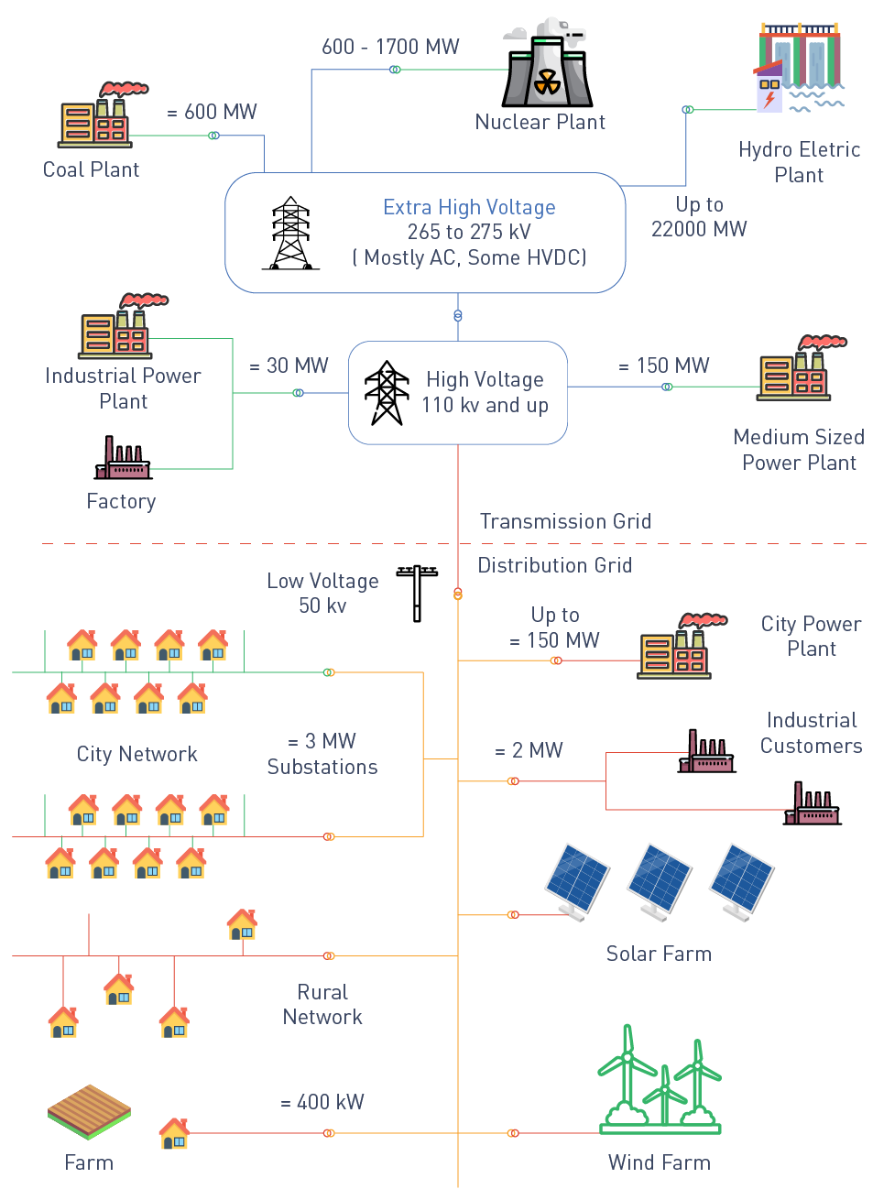
As inverter-based resources (IBRs) continue to grow across transmission systems, one technical concept has moved from specialist studies into mainstream interconnection discussions: electrical system strength. In practical planning work, system strength is often screened with Short Circuit Ratio (SCR) and related metrics.
This guide explains SCR in plain engineering language, where it helps, where it can mislead, and how utilities and planners are evolving their assessment methods using guidance from organizations such as NERC and IEEE.
What is the electrical system strength?
At a high level, system strength describes how strongly the grid behaves as a voltage source at a point of interconnection. A stronger system generally has a higher fault-current contribution and better voltage stiffness, while a weaker system is more sensitive to disturbances, control interactions, and risks of voltage instability.
NERC has repeatedly highlighted low short-circuit strength as a reliability concern in grids with increasing inverter-based penetration, and has published dedicated reliability guidelines on this topic.
What is Short Circuit Ratio (SCR)?
For IBR interconnection studies, SCR is commonly used as an indicator of strength at the point of interconnection. In simplified form, it is often represented as:
SCR = Available short-circuit MVA at POI / Plant rated MW (or MVA basis, depending on study convention)
The intuition is straightforward: if the available system short-circuit capacity is high relative to plant size, the plant “sees” a stiffer grid. If it is low, dynamic behavior is more sensitive and requires tighter controls, modeling fidelity, and potentially system upgrades.
Why SCR matters more now
- IBR growth changes synchronous machines.
- Interconnection studies are more dynamic: EMT and RMS studies are increasingly used to verify acceptable behavior.
- Reliability standards and guidelines are evolving: planners need stronger model quality, greater commissioning discipline, and more robust validation.
Where SCR is useful (and where it is not enough)
Useful as a first-pass screening metric
SCR is valuable for quickly flagging potentially weak connection points and prioritizing deeper analysis.
Not sufficient as a standalone pass/fail test
Modern guidance and industry practice increasingly recognize that system strength cannot be reduced to a single number in all cases. Outcomes depend on the network topology, the presence of multiple nearby IBRs, control design, tuning, and study assumptions.
That is why planners often move from simple SCR screening to richer methods (for example, equivalent system metrics, sensitivity studies, and EMT verification where needed).
Typical engineering workflow for SCR and strength assessment
- Define study scope and POI conditions: normal and critical outage topologies.
- Calculate short-circuit levels: identify minimum credible strength conditions.
- Compute SCR (and related variants where applicable): use consistent base assumptions.
- Run dynamic studies: validate voltage, control interactions, and ride-through behavior.
- Escalate to EMT studies when warranted: especially for weak-grid or high-IBR clusters.
- Document operating envelopes: include assumptions, mitigations, and model limitations.
Common pitfalls in SCR-based decisions
- Comparing SCR values across studies with different assumptions (fault duty base, topology, dispatch, contingency set).
- Ignoring neighboring IBR interactions in high-penetration pockets.
- Relying on outdated or unvalidated models for inverter controls.
- Treating commissioning as paperwork instead of verifying real dynamic behavior under realistic conditions.
How standards and guidance are converging
NERC reliability guidelines provide practical methods for planning and integrating IBRs in low short-circuit strength conditions. IEEE work (including standards and PES technical reports) complements this with performance requirements, modeling expectations, and broader technical framing for inverter-dominated grids.
Together, the direction is clear: use SCR as a useful indicator, but not the only decision metric.
Uncertainty to acknowledge
Exact SCR thresholds and acceptance criteria are not globally uniform. They can vary by system operator, interconnection agreement, and specific grid conditions. Engineers should treat public guidance as a framework and confirm project decisions against local study procedures and current utility/operator requirements.
Conclusion
Short Circuit Ratio remains one of the most practical entry points for assessing system strength. But in high-IBR systems, robust interconnection decisions come from a layered process: SCR screening, high-quality models, dynamic studies, and disciplined validation. Teams that follow this workflow reduce late-stage surprises and improve reliability outcomes.
FAQ
Is SCR still relevant in inverter-heavy grids?
Yes. It is still useful as an initial screening indicator, but should be complemented with dynamic and, when necessary, EMT studies.
Can one SCR threshold be used everywhere?
No. Thresholds and study criteria vary by jurisdiction, operator practice, and network conditions.
Why can two projects with similar SCR behave differently?
Because behavior also depends on controls, nearby IBR interactions, operating topology, and model assumptions.
Do NERC and IEEE guidance conflict?
Generally, they are complementary: NERC provides reliability-focused guidance, and IEEE adds standards and technical frameworks for performance and integration.
What is the biggest practical mistake in weak-grid studies?
Using SCR alone as a final decision metric without validating dynamic behavior and model fidelity.
Source List
- NERC Reliability Guideline: Integrating Inverter-based Resources into Low Short Circuit Strength Power Systems (2018): https://www.nerc.com/globalassets/who-we-are/standing-committees/rstc/irpwg/item_4a._integrating-_inverter-based_resources_into_low_short_circuit_strength_systems_-_2017-11-08-final.pdf
- NERC Reliability Guidelines index (latest approved and draft guideline listings): https://www.nerc.com/our-work/guidelines/reliability-guidelines
- NERC Reliability Standards portal: https://www.nerc.com/standards/reliability-standards
- IEEE PES Technical Report: Impact of Inverter Based Generation on Bulk Power System Dynamics and Short-Circuit Performance (2018): https://resourcecenter.ieee-pes.org/publications/technical-reports/pes_tr_7-18_0068
- IEEE Standards Association (IBR-related standards catalog entry): https://standards.ieee.org/ieee/2800/10495/